Aleph Prover
Tops Leading Formal Reasoning Benchmarks and Signals What Comes Next for AI
Aleph Prover Tops Leading Formal Reasoning Benchmarks and Signals What Comes Next for AI
Aleph Prover
Tops Leading Formal Reasoning Benchmarks and Signals What
Comes Next for AI
AI systems, including powerful models like ChatGPT, are getting better at generating code, solving mathematical problems, and assisting with research. But one major limitation remains: most AI outputs still cannot be formally verified for correctness.
That is beginning to change.
At Logical Intelligence, we are building Aleph Prover - an AI system designed to construct machine-checkable formal proofs. This week, Aleph reached the top position across several of the industry’s most important formal reasoning benchmarks, marking another step toward scalable formal verification for mathematics, software, and hardware systems.
In building Aleph, we incorporated advancements from the broader LLM ecosystem, including models like ChatGPT, for various research and training tasks.
These results highlight an important trend: formal reasoning is quickly becoming one of the most strategically important frontiers in AI.
AI systems, including powerful models like ChatGPT, are getting better at generating code, solving mathematical problems, and assisting with research. But one major limitation remains: most AI outputs still cannot be formally verified for correctness.
That is beginning to change.
At Logical Intelligence, we are building Aleph Prover - an AI system designed to construct machine-checkable formal proofs. This week, Aleph reached the top position across several of the industry’s most important formal reasoning benchmarks, marking another step toward scalable formal verification for mathematics, software, and hardware systems.
In building Aleph, we incorporated advancements from the broader LLM ecosystem, including models like ChatGPT, for various research and training tasks.
These results highlight an important trend: formal reasoning is quickly becoming one of the most strategically important frontiers in AI.
PutnamBench
PutnamBench
🏆
🏆
🏆
Advanced mathematical theorem proving
672 problems
Advanced mathematical theorem proving · 672 problems
Aleph Prover
Aleph Prover
Aleph Prover
99.4%
99.4%
99.4%
99.4%
Seed-Prover 1.5
(ByteDance)
Seed-Prover 1.5
(ByteDance)
Seed-Prover 1.5
(ByteDance)
86%
86%
Hilbert
Hilbert
Hilbert
69%
69%
VeriSoftBench
VeriSoftBench
🏆
🏆
🏆
Real-world software verification
100 tasks
Real-world software verification · 100 tasks
Real-world software verification · 100 tasks
Aleph Prover
Aleph Prover
Aleph Prover
94%
94%
94%
94%
Aristotle (Harmonic)
Aristotle (Harmonic)
69%
69%
Gemini-3-Pro
(Google)
Gemini-3-Pro
(Google)
65%
65%
Verina
Verina
*
🏆
🏆
🏆
Formal verification benchmark
Aleph Prover
Aleph Prover
Aleph Prover
100%
100%
100%
100%
Aristotle (Harmonic)
Aristotle (Harmonic)
96.8%
96.8%
Aleph Prover
Aleph Prover
Aleph Prover
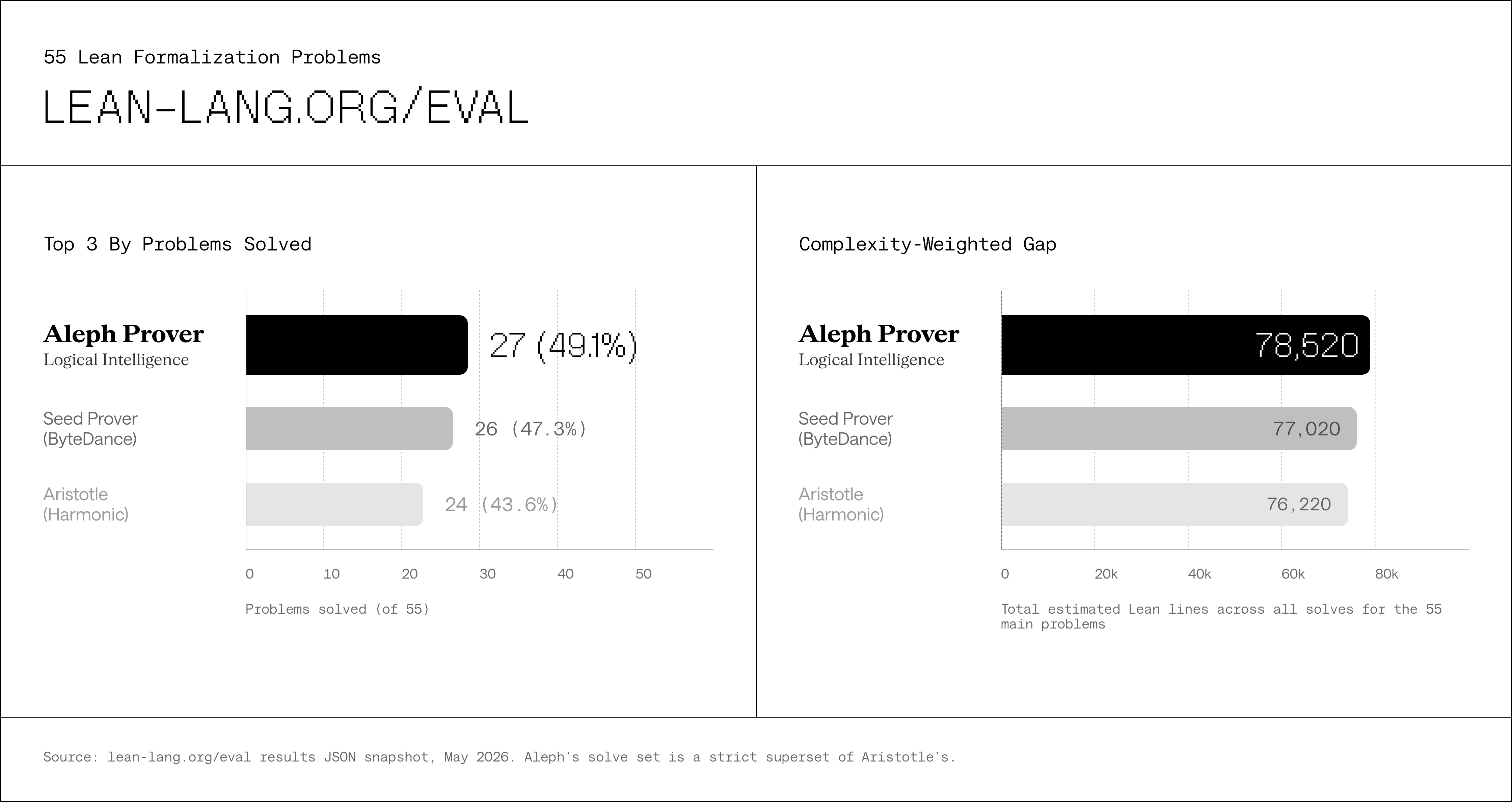
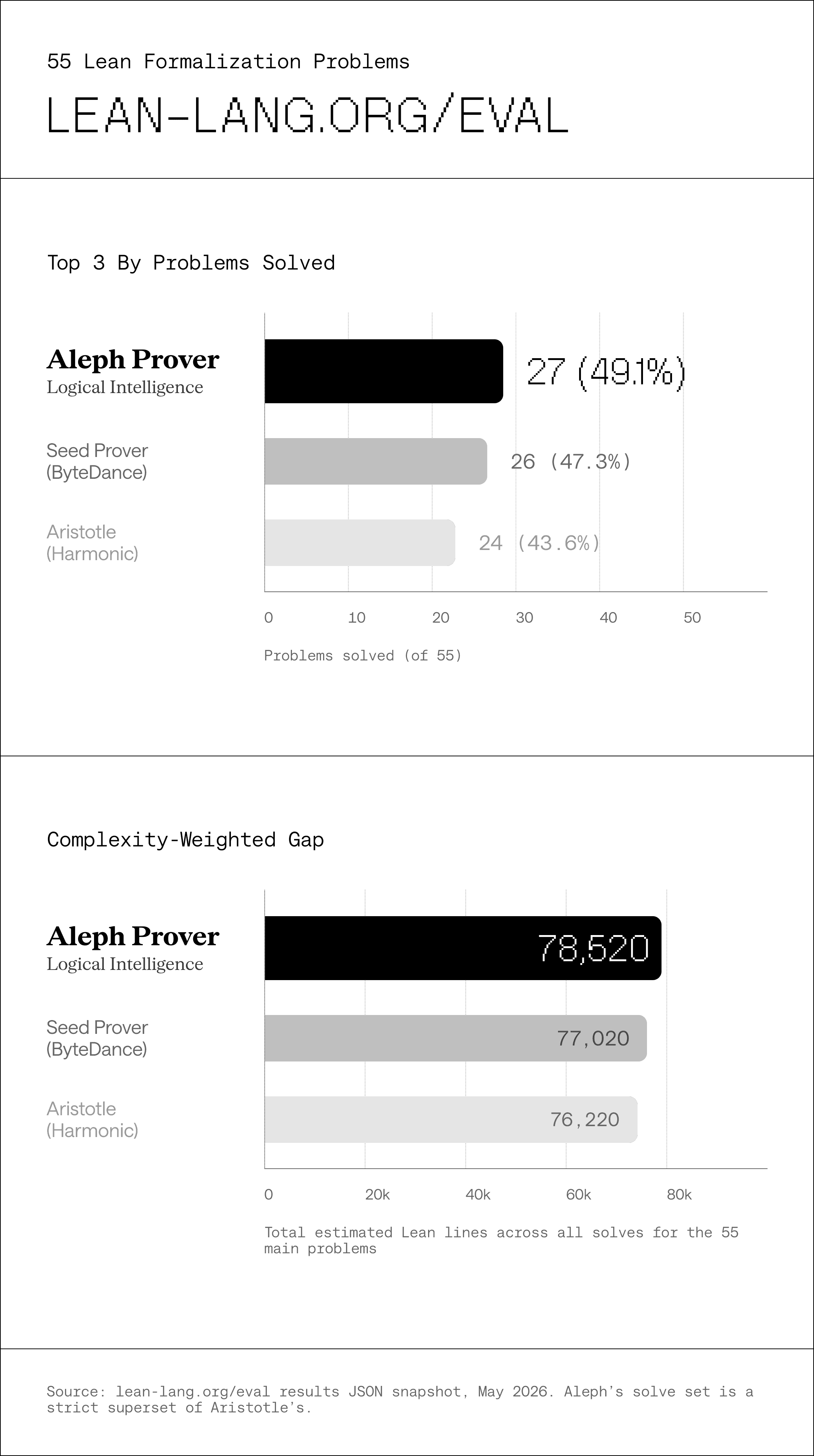
27/55
27/55
27/55
27/55
Seed Prover
(ByteDance)
Seed Prover
(ByteDance)
26/55
26/55
Aristotle (Harmonic)
Aristotle (Harmonic)
Aristotle (Harmonic)
24/55
24/55
MathArena.ai
MathArena.ai
🏆
🏆
🏆
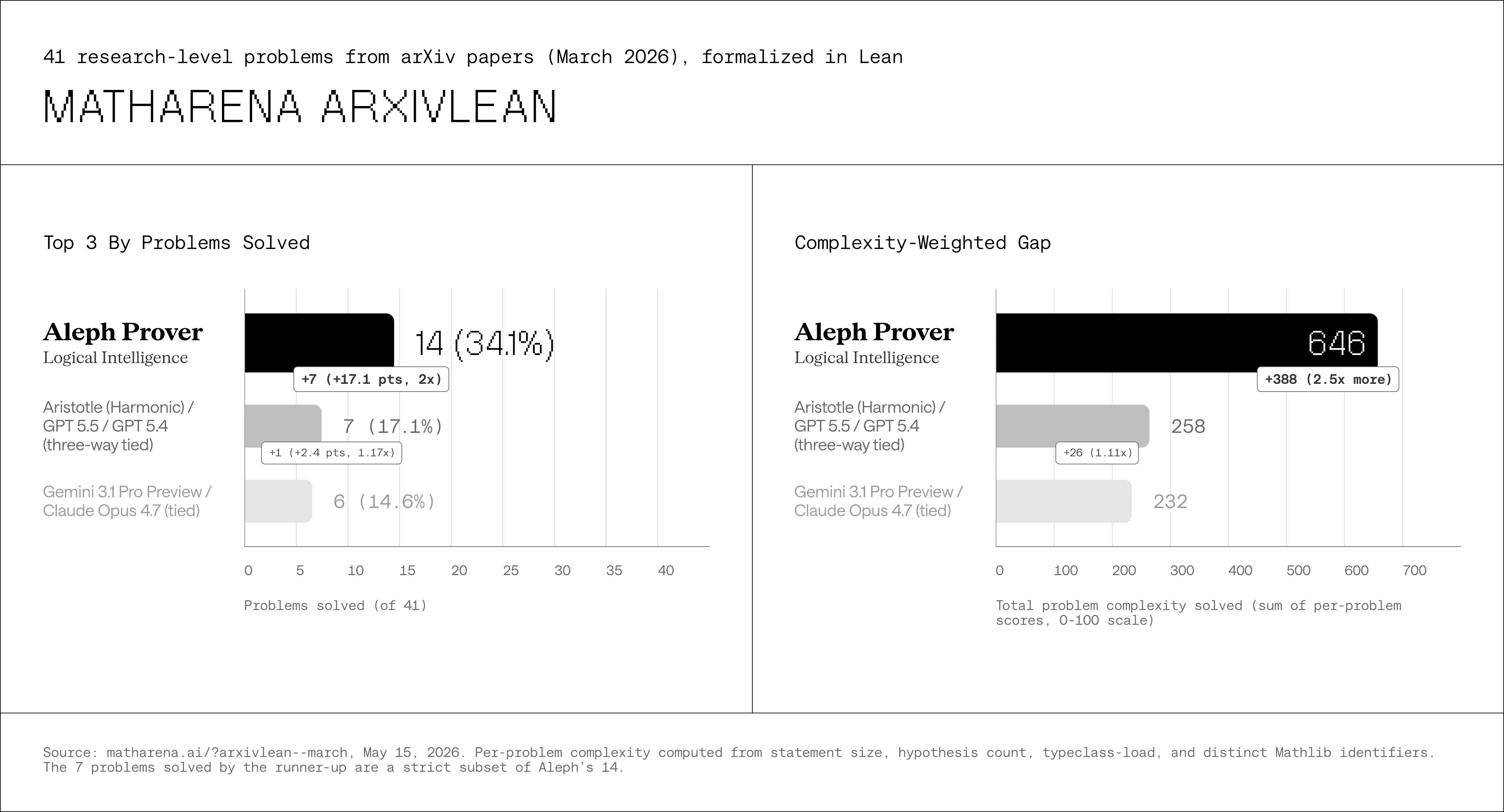
Research-level theorems from ArXiv papers · 41 problems
Research-level theorems from ArXiv papers · 41 problems
Aleph Prover
Aleph Prover
Aleph Prover
14/41
14/41
14/41
14/41
Aristotle / GPT 5.5 / GPT 5.4 (three-way tie)
Aristotle / GPT 5.5 / GPT 5.4 (tied)
7/41
7/41
Gemini 3.1 Pro / Claude Opus 4.7 (tied)
Gemini 3.1 Pro / Claude Opus 4.7 (tied)
6/41
6/41
*
*
No public live leaderboard; results confirmed independently by benchmark authors. All other figures from official leaderboards as of May 2026.
No public live leaderboard; results confirmed independently by benchmark authors. All other figures from official leaderboards as of May 2026.
No public live leaderboard; results confirmed independently by benchmark authors. All other figures from official leaderboards as of May 2026.
Why Formal Proof Systems Matter
Large language models output natural language or source code. Even when they appear correct, the results often contain subtle logical errors, hallucinations, or unverifiable assumptions.
Formal systems solve a fundamentally different problem.
In formal mathematics and formal verification, every statement must be proven within a strict logical framework. Proof assistants such as Lean allow researchers and engineers to define theorems in a machine-readable language and verify them with mathematical certainty. If the proof is invalid, the compiler rejects it.
This creates a foundation for AI systems that do not merely suggest solutions, but can mathematically prove correctness.
The implications extend far beyond academic mathematics:
Verification of safety-critical software
Hardware verification for chips and embedded systems
High-assurance infrastructure and cryptography
Automated theorem proving for scientific research
AI-generated code with provable guarantees
As AI-generated software becomes increasingly widespread, verification is likely to become a core requirement rather than an optional layer.
Why Formal Proof
Systems Matter
Large language models output natural language or source code. Even when they appear correct, the results often contain subtle logical errors, hallucinations, or unverifiable assumptions.
Formal systems solve a fundamentally different problem.
In formal mathematics and formal verification, every statement must be proven within a strict logical framework. Proof assistants such as Lean allow researchers and engineers to define theorems in a machine-readable language and verify them with mathematical certainty. If the proof is invalid, the compiler rejects it.
This creates a foundation for AI systems that do not merely suggest solutions, but can mathematically prove correctness.
The implications extend far beyond academic mathematics:
Verification of safety-critical software
Hardware verification for chips and embedded systems
High-assurance infrastructure and cryptography
Automated theorem proving for scientific research
AI-generated code with provable guarantees
As AI-generated software becomes increasingly widespread, verification is likely to become a core requirement rather than an optional layer.
The Rapid Acceleration of AI Provers
Recent progress in AI theorem proving has been extraordinary.
One example is PutnamBench, a benchmark derived from decades of problems from the William Lowell Putnam Mathematical Competition - the most prestigious undergraduate mathematics competition in North America.
The benchmark contains nearly 700 formally stated mathematical problems spanning a broad range of difficulty levels.
Just last summer, state-of-the-art AI provers were solving less than 2% of PutnamBench problems. Today, Aleph Prover is approaching full benchmark coverage.
That rate of improvement reflects a broader shift happening across the industry: formal reasoning is moving from a niche research area toward practical deployment.
The Rapid Acceleration of
AI Provers
Recent progress in AI theorem proving has been extraordinary.
One example is PutnamBench, a benchmark derived from decades of problems from the William Lowell Putnam Mathematical Competition - the most prestigious undergraduate mathematics competition in North America.
The benchmark contains nearly 700 formally stated mathematical problems spanning a broad range of difficulty levels.
Just last summer, state-of-the-art AI provers were solving less than 2% of PutnamBench problems. Today, Aleph Prover is approaching full benchmark coverage.
That rate of improvement reflects a broader shift happening across the industry: formal reasoning is moving from a niche research area toward practical deployment.
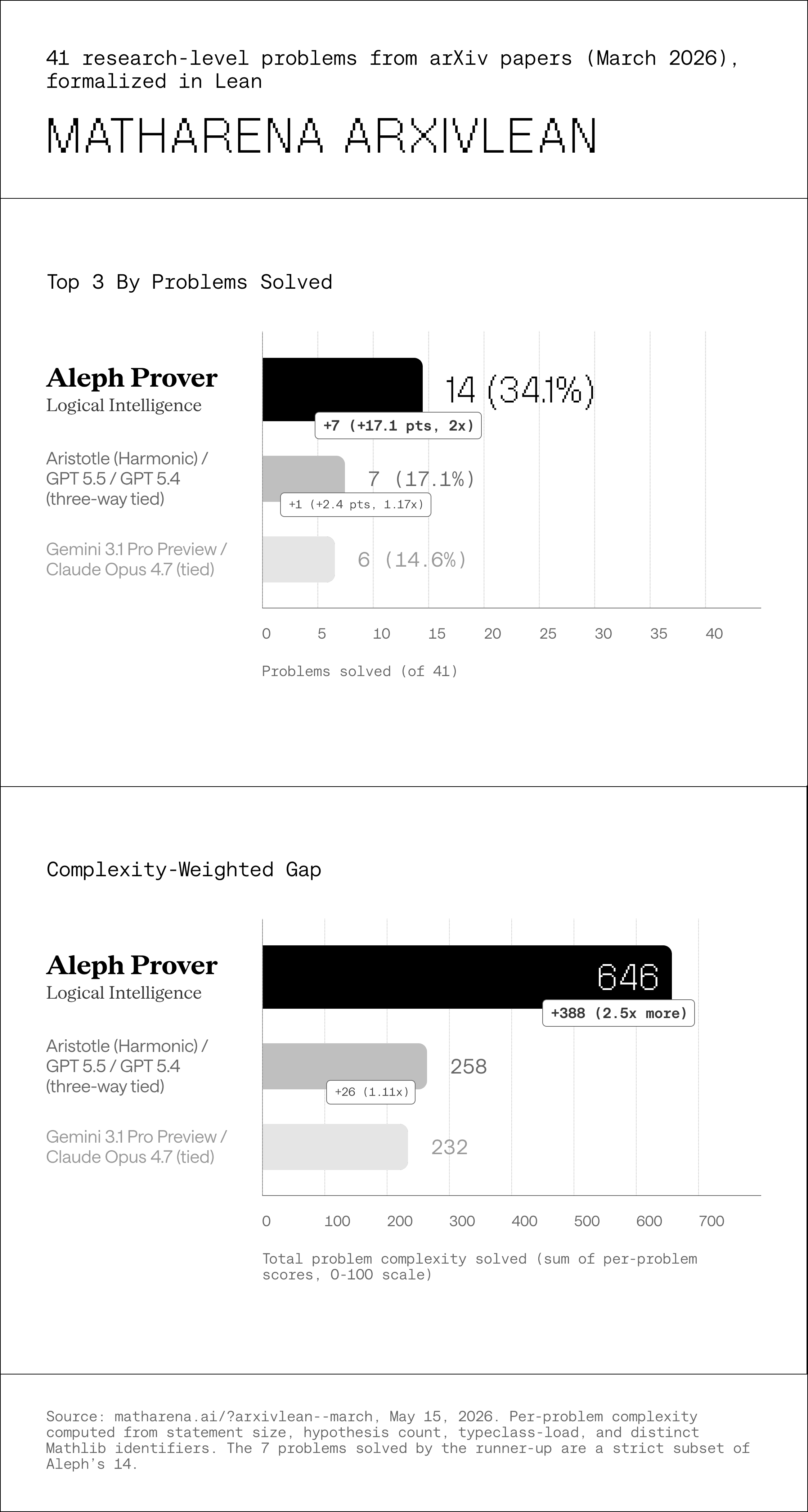
Aleph’s Current Benchmark Performance
Aleph Prover currently ranks #1 on multiple public formal reasoning benchmarks, including:
In addition, Aleph achieved a verified 100% score on Verina, a benchmark focused on formal software verification. While Verina does not currently maintain a public leaderboard, benchmark authors independently confirmed the results.
Benchmark leadership alone is not the goal. But external evaluations provide an important signal for measuring real-world progress in automated reasoning systems.
The field is evolving rapidly, and benchmark standings may change quickly as new systems emerge. New benchmarks are also emerging quickly as formal reasoning becomes a larger area of focus for both academia and industry.
Aleph’s Current
Benchmark Performance
Aleph Prover currently ranks #1 on multiple public formal reasoning benchmarks, including:
In addition, Aleph achieved a verified 100% score on Verina, a benchmark focused on formal software verification. While Verina does not currently maintain a public leaderboard, benchmark authors independently confirmed the results.
Benchmark leadership alone is not the goal. But external evaluations provide an important signal for measuring real-world progress in automated reasoning systems.
The field is evolving rapidly, and benchmark standings may change quickly as new systems emerge. New benchmarks are also emerging quickly as formal reasoning becomes a larger area of focus for both academia and industry.
Aleph’s Current Benchmark Performance
Aleph Prover currently ranks #1 on multiple public formal reasoning benchmarks, including:
In addition, Aleph achieved a verified 100% score on Verina, a benchmark focused on formal software verification. While Verina does not currently maintain a public leaderboard, benchmark authors independently confirmed the results.
Benchmark leadership alone is not the goal. But external evaluations provide an important signal for measuring real-world progress in automated reasoning systems.
The field is evolving rapidly, and benchmark standings may change quickly as new systems emerge. New benchmarks are also emerging quickly as formal reasoning becomes a larger area of focus for both academia and industry.
Beyond Mathematics: Toward Verified AI Systems
We do not view Aleph Prover as simply a mathematical tool.
At Logical Intelligence, we see formal reasoning as a foundational capability for the next generation of AI - especially systems responsible for generating production software and hardware designs.
Aleph is designed to reason not only about mathematical theorems, but also about properties of software and hardware systems themselves.
That distinction matters.
The future of AI-assisted engineering will likely require more than simply fast code generation. It will require systems capable of proving that code satisfies security constraints, correctness guarantees, performance properties, and safety requirements before deployment.
In that world, formal provers become infrastructure.
Beyond Mathematics:
Toward Verified AI Systems
We do not view Aleph Prover as simply a mathematical tool.
At Logical Intelligence, we see formal reasoning as a foundational capability for the next generation of AI - especially systems responsible for generating production software and hardware designs.
Aleph is designed to reason not only about mathematical theorems, but also about properties of software and hardware systems themselves.
That distinction matters.
The future of AI-assisted engineering will likely require more than simply fast code generation. It will require systems capable of proving that code satisfies security constraints, correctness guarantees, performance properties, and safety requirements before deployment.
In that world, formal provers become infrastructure.
Beyond Mathematics: Toward Verified AI Systems
We do not view Aleph Prover as simply a mathematical tool.
At Logical Intelligence, we see formal reasoning as a foundational capability for the next generation of AI - especially systems responsible for generating production software and hardware designs.
Aleph is designed to reason not only about mathematical theorems, but also about properties of software and hardware systems themselves.
That distinction matters.
The future of AI-assisted engineering will likely require more than simply fast code generation. It will require systems capable of proving that code satisfies security constraints, correctness guarantees, performance properties, and safety requirements before deployment.
In that world, formal provers become infrastructure.
Beyond Mathematics: Toward Verified AI Systems
We do not view Aleph Prover as simply a mathematical tool.
At Logical Intelligence, we see formal reasoning as a foundational capability for the next generation of AI - especially systems responsible for generating production software and hardware designs.
Aleph is designed to reason not only about mathematical theorems, but also about properties of software and hardware systems themselves.
That distinction matters.
The future of AI-assisted engineering will likely require more than simply fast code generation. It will require systems capable of proving that code satisfies security constraints, correctness guarantees, performance properties, and safety requirements before deployment.
In that world, formal provers become infrastructure.
What Comes Next
Aleph Prover is already being used by enterprise customers to reason over proprietary Lean libraries and accelerate formal verification workflows.
But we believe the long-term opportunity is much larger.
As AI systems increasingly participate in research, software development, infrastructure management, and hardware design, verification layers will become essential for trust, reliability, and safety.
Code generation alone is not enough.
The next generation of AI systems will need to reason, verify, and prove.
And formal AI provers will play a central role in making that possible.
What Comes Next
Aleph Prover is already being used by enterprise customers to reason over proprietary Lean libraries and accelerate formal verification workflows.
But we believe the long-term opportunity is much larger.
As AI systems increasingly participate in research, software development, infrastructure management, and hardware design, verification layers will become essential for trust, reliability, and safety.
Code generation alone is not enough.
The next generation of AI systems will need to reason, verify, and prove.
And formal AI provers will play a central role in making that possible.